Best Canon IXUS Cameras to Buy in Australia (2026)
Canon made an extraordinary number of compact cameras, but one name keeps turning up in bags, drawers, Marketplace searches and late-night “which digicam should I buy?” tabs.
Tested & written by Dear Digi · every camera we sell is photographed and tested by hand before it goes on the shelf.
Part of the appeal is obvious. They are small, beautifully designed and usually simple enough that you can hand one to a friend without explaining anything. But the IXUS line also ran for years, and a 2007 IXUS 75 is a very different camera from a 2013 IXUS 135 or a 2017 IXUS 185.
So there is no single “best IXUS”.
There is, however, a best one for the way you actually want to use it.
The short answer
If you do not want to read the whole guide, this is where we would start.
| Camera | Best for | Why we like it | Main trade-off |
|---|---|---|---|
| Canon IXUS 80 IS | Best all-round classic | Tiny, optical stabilisation, classic 2008 CCD-era IXUS | 3× zoom starts at a fairly narrow 38mm equivalent |
| Canon IXUS 100 IS | Best for pocketability and design | Exceptionally slim stainless-steel body, 12.1MP CCD | Short 3× zoom |
| Canon IXUS 860 IS | Best older IXUS for travel and groups | Useful 28mm wide end, 3.8× zoom, optical IS | Bigger than the smallest IXUS bodies |
| Canon IXUS 95 IS | Best straightforward first IXUS | Simple 3× lens, optical IS, 10MP CCD | Less distinctive on paper than the cult models |
| Canon IXUS 220 HS | Best for low light and video | 24mm wide lens, bright f/2.7 wide end, 5× zoom and Full HD | CMOS, if you specifically want an older CCD camera |
| Canon IXUS 135 | Best later-generation all-rounder | 8× zoom, 28mm wide end, Wi-Fi and a slim body | Less of the early-2000s IXUS feel |
| Canon IXUS 145 | Best sleeper value | Simple, light and useful 8× zoom without the hype | Fewer convenience features than the 135 |
| Canon IXUS 185 | Best simple newer IXUS | Lightweight, 8× zoom, 20MP CCD and Easy Auto | Newer look and feel than the early IXUS favourites |
If we had to reduce the entire list to three, it would be the IXUS 80 IS for the classic experience, IXUS 100 IS for the design and pocketability, and IXUS 220 HS for the strongest all-round specification.
But those three are not automatically the right answer for everyone.
Why the IXUS name still matters
The first Digital IXUS arrived in 2000, when a genuinely pocketable digital camera still felt futuristic. Canon built the line around compactness, simple operation and design that did not look like a miniature piece of office equipment.
That mattered then, and strangely, it matters again now.
A lot of old digital cameras take perfectly enjoyable pictures. The IXUS advantage is that many of them are genuinely pleasant objects to carry. They are small enough to disappear into a pocket, their controls tend to be uncomplicated, and Canon produced them in finishes that ranged from restrained silver and black to pink, red, blue and gold.
That combination is one reason the series has survived the digicam revival better than many technically similar competitors.
There is also a practical advantage when shopping second-hand: IXUS was a huge family. You do not need to pay whatever the internet is asking for one viral model. There are plenty of excellent alternatives.

A useful naming trick: IXUS, IXY and ELPH
If you are shopping internationally, the exact same camera may appear under a different name.
Canon generally used IXUS in Europe, Australia and other markets, IXY in Japan and Digital ELPH / ELPH in North America.
For example, the Canon IXUS 100 IS was sold in North America as the PowerShot SD780 IS Digital ELPH, while the IXUS 220 HS was sold there as the PowerShot ELPH 300 HS.
That is useful because searching all of a model's regional names can uncover batteries, manuals, accessories and sometimes cameras that would never appear in an “IXUS” search.
How we chose the cameras in this guide
We are not ranking these by megapixels.
We care more about five things:
Is it small enough to take with you?
A technically superior compact that
stays at home is a worse camera than the one that lives in your bag.
Does the lens make sense for how you shoot?
A wide 24mm or 28mm
equivalent lens is genuinely useful for travel, groups and interiors. A 3× lens can be
completely enough for dinners, portraits and nights out.
Does the flash work?
For a lot of people buying a digicam now, the
direct-flash look is half the point.
Can you still live with the battery and memory card?
A rare camera
becomes much less charming if its battery lasts ten minutes or its storage is difficult to
replace.
Is the individual camera healthy?
Condition beats reputation. A properly
tested, less-hyped IXUS is a better purchase than a famous one with a struggling lens
motor.
If this is your first digicam, our beginner guide goes deeper into exactly what to check.
Canon IXUS 80 IS — the best all-round classic
2008 · 8MP CCD · 3× optical zoom · optical IS
If somebody asked us to explain the appeal of the IXUS line with one camera, the IXUS 80 IS would be an easy place to start.
It is tiny without feeling toy-like. Canon gave it an aluminium body, a 2.5-inch screen, an optical viewfinder, a 3× zoom and lens-shift image stabilisation. The lens covers a 38–114mm-equivalent range, which is not particularly wide by modern standards, but suits people, dinners, everyday snapshots and direct-flash photographs very naturally.
Its 8-megapixel CCD is not impressive because it is eight megapixels. It is impressive because you do not need more for the way most people use one of these cameras now.
The 80 IS also came in several colours, which has helped turn certain versions into collectable objects. We would still choose on condition before colour.
Who should buy it?
Someone who wants the archetypal late-2000s IXUS: small, simple, metal-bodied and easy to bring everywhere.
What would make us hesitate?
The lens starts at a 38mm equivalent, so it is noticeably tighter than an IXUS 860 IS, 220 HS or 135 when you are trying to fit a group around a restaurant table.
Our verdict: if you want one classic IXUS and do not need a wide lens, this is the safest place to begin.

Canon IXUS 100 IS — the one we would carry everywhere
2009 · 12.1MP CCD · 3× optical zoom · optical IS
The IXUS 100 IS is one of those cameras whose appeal makes more sense in your hand than on a specification sheet.
Canon made the body just 18.4mm thick, which made it the slimmest IXY/IXUS-series model at launch. It uses a stainless-steel exterior and was offered in silver, gold, black and red.
The 3× lens is modest, but that is almost beside the point. The reason to buy a 100 IS is that it asks so little of you. It is the sort of camera that can sit in a small bag all week without becoming “camera gear”.
Compared with the IXUS 80 IS, you get a slightly wider 33mm-equivalent starting point and a 12.1-megapixel CCD. The real difference, though, is the shape. The 100 IS feels deliberately reduced to the essentials.
Who should buy it?
Someone who values size and design as much as zoom range, especially for everyday carry, dinners, parties and travel.
What would make us hesitate?
If you regularly photograph distant subjects, 3× zoom becomes limiting quickly.
Our verdict: probably the most elegant answer to “which IXUS will I actually remember to bring?”
Canon IXUS 860 IS — the older IXUS we would take travelling
2007 · 8MP CCD · 28mm wide angle · 3.8× optical zoom · optical IS
The IXUS 860 IS is less jewel-like than the 80 IS or 100 IS, but it solves one of their biggest practical limitations.
Its lens starts at a 28mm-equivalent field of view.
That difference sounds small until you are trying to photograph three friends across a table, a building from the other side of a narrow street or the inside of a hotel room. Suddenly, 28mm feels enormously more useful than 38mm.
The 860 IS pairs that wider lens with a 3.8× zoom, optical image stabilisation and a large 3-inch rear screen. It still gives you an 8-megapixel CCD and DIGIC III-era Canon compact experience, but with a lens that is easier to live with on trips.
Who should buy it?
Travellers, group-photo people and anyone who wants an older CCD IXUS without feeling boxed in by a narrow lens.
What would make us hesitate?
It is not as tiny or visually minimal as the smallest IXUS models.
Our verdict: one of the most sensible “old” IXUS cameras if you care about using it rather than simply collecting it.

Canon IXUS 95 IS — the underrated first IXUS
2009 · 10MP CCD · 3× optical zoom · optical IS
The IXUS 95 IS is easy to overlook because it does not have one headline feature people obsess over.
That is exactly why we like it as a first camera.
It has a 10-megapixel CCD, a 35–105mm-equivalent 3× lens, optical image stabilisation and a straightforward 2.5-inch screen. Nothing about it is excessive. Nothing needs a tutorial.
It sits in a particularly nice part of the IXUS timeline: modern enough to be easy to operate, old enough to still feel distinctly like a compact camera from before phones became the default.
Who should buy it?
Someone who wants a classic Canon compact without paying extra simply because a particular model or colour is trending.
What would make us hesitate?
If an IXUS 80 IS, 100 IS or 860 IS is available in equally good condition for similar money, those models each have a more distinctive reason to choose them.
Our verdict: a very good reminder that the least hyped camera can be the smartest purchase.
Canon IXUS 220 HS — the best IXUS if CCD is not a requirement
2011 · 12.1MP CMOS · 24mm wide angle · 5× optical zoom · Full HD
This is where the IXUS conversation gets more interesting.
The IXUS 220 HS does not use a CCD sensor. It uses a 12.1-megapixel CMOS sensor as part of Canon's HS System.
That will immediately remove it from some TikTok shopping lists, which is a mistake if your actual priorities are low-light usability, a wider lens and better video.
The 220 HS has a 24–120mm-equivalent 5× zoom, a bright f/2.7 aperture at the wide end, a slim 19.5mm body and Full HD video. In practical terms, it is one of the most versatile truly pocketable cameras in this group.
It is also a useful reality check for the idea that “CCD” and “good digicam” are interchangeable phrases. They are not.
Who should buy it?
Someone who wants one tiny camera for nights out, travel, everyday stills and casual video.
What would make us hesitate?
If the entire reason you are shopping is specifically to own an older CCD camera, this is not one.
Our verdict: the strongest all-round specification here, and one of the easiest IXUS models to recommend on usefulness alone.

The direct-flash look people associate with digicams comes mostly from the flash, the subject and the dark behind them — not from the sensor. This one is a CCD IXUS 80 IS, but a CMOS 220 HS in the same street would look far more alike than different.
Canon IXUS 135 — the practical later-generation choice
2013 · 16MP · 8× optical zoom · 28mm wide angle · Wi-Fi
By 2013, compact cameras were already fighting for space against increasingly capable smartphones. The IXUS 135 feels like a product of that moment.
It remains slim, but the lens stretches from a useful 28mm-equivalent wide angle all the way to 224mm equivalent. That 8× range makes it far more flexible on holiday than the little 3× models.
It also adds Wi-Fi, which sounds ordinary now but was a meaningful convenience feature in a compact camera of this era.
The IXUS 135 makes sense if you want the size and simplicity of an IXUS but do not want to give up useful zoom range.
Who should buy it?
Travellers, beginners and people who want one compact to cover more situations without moving into a chunky superzoom.
What would make us hesitate?
If what you specifically love is the minimal metal-camera character of the mid-to-late 2000s IXUS line, the 135 feels more modern and functional.
Our verdict: less romantic, more useful — and that is a compliment.
Canon IXUS 145 — the sleeper pick
2014 · 16MP · 8× optical zoom · DIGIC 4+
The IXUS 145 is not a camera people usually build mood boards around.
That can work in your favour.
It gives you an 8× 28–224mm-equivalent zoom in a body only a little over 22mm thick, with the simplified operation you expect from a later IXUS.
For somebody who wants to actually use the camera rather than chase a particular model name, that is a very sensible combination.
Who should buy it?
Someone who wants a later, easy-to-use IXUS with useful zoom and would rather pay for condition than hype.
What would make us hesitate?
It lacks some of the charm and convenience features that make the 135 or older metal-bodied models more distinctive.
Our verdict: one to buy when the individual camera is excellent and the price makes sense.
Canon IXUS 185 — the easiest newer IXUS
2017 · 20MP CCD · 8× optical zoom · Easy Auto
The IXUS 185 arrived much later than the cameras most people picture when they hear “vintage digicam”.
That is exactly why it deserves a place here.
It weighs around 126g with battery and card, has an 8× 28–224mm-equivalent zoom, a 20-megapixel CCD and an Easy Auto mode designed to stop accidental settings changes.
If you are buying for somebody who wants to turn the camera on and take pictures — no interest in menus, no desire to learn exposure modes — the 185 makes a lot of sense.
Who should buy it?
First-time camera owners, casual travellers and anyone who prioritises simplicity.
What would make us hesitate?
If you want the design language and technological limitations of a mid-2000s compact, this is a much later interpretation of the IXUS idea.
Our verdict: arguably the least intimidating camera on this list.
Canon IXUS 75 — the one for early-digicam character
2007 · 7.1MP CCD · 3× optical zoom · 3-inch LCD
The IXUS 75 belongs to an earlier moment in compact-camera design.
It has a 7.1-megapixel CCD, a simple 35–105mm-equivalent 3× lens and a surprisingly large 3-inch rear screen. There is no optical image stabilisation.
What makes it interesting now is how little there is between you and taking the photograph. The specification is basic, the body is slim, and the camera is unmistakably from the period people are currently trying to recreate.
That does not make it automatically better.
It makes it specific.
Who should buy it?
Someone who deliberately wants a mid-2000s Canon compact and is comfortable accepting older-camera limitations.
What would make us hesitate?
No optical IS, increasing age, and the fact that condition now varies enormously from camera to camera.
Our verdict: buy a good one because you want a 2007 IXUS — not because somebody told you 7 megapixels is secretly magical.
CCD vs CMOS: should it decide which IXUS you buy?
No.
It can influence your choice. It should not make the choice for you.
The IXUS 75, 80 IS, 95 IS, 100 IS and many other classic models use CCD sensors. The IXUS 220 HS uses CMOS.
That fact alone does not tell you which photograph you will prefer.
Lens design, flash, exposure, white balance, Canon's processing, the light you are shooting in and how close you are to your subject all matter.
A direct-flash photograph from a CMOS IXUS 220 HS can look far more “digicam” than a daylight landscape from a CCD camera. The sensor is part of the camera, not a preset.
If you specifically want to collect CCD models, that is completely reasonable. Just do not mistake a sensor technology for an entire aesthetic.
Which Canon IXUS would we buy?
If it were our money, we would choose according to the life the camera is going into.
For nights out and everyday carry: IXUS 80 IS or IXUS 100 IS.
For one tiny camera that does almost everything: IXUS 220 HS.
For travel and groups: IXUS 860 IS or IXUS 135.
For a straightforward first camera without chasing hype: IXUS 95 IS or IXUS 145.
For the easiest point-and-shoot experience: IXUS 185.
For deliberately early-digital character: IXUS 75.
The important part is that these are categories, not commandments.
A beautifully kept IXUS 95 IS with a healthy battery and perfect lens mechanism is a better purchase than a battered IXUS 80 IS simply because the 80 is more popular.
Canon IXUS cameras currently on the shelf
These come straight from current stock, so what you see here should always be an IXUS that is genuinely available. When one sells, it leaves this list on its own.
How much should a Canon IXUS cost in Australia?
There is no useful fixed price list anymore.
The second-hand compact-camera market has become unusually emotional. Colour, condition, celebrity exposure, social-media popularity and simple scarcity can move the price of two technically similar cameras surprisingly far apart.
That means the cheapest IXUS is not always the bargain, and the most expensive one is certainly not always the best.
We would pay more for:
- a camera that has been properly tested
- a clean lens mechanism that extends and retracts without hesitation
- a working flash
- responsive buttons
- a healthy battery
- the correct charger
- a compatible memory card
- clear photographs of the exact camera being sold
- a seller who explains faults instead of hiding them
We would be much less interested in paying a premium simply because the camera is pink, currently viral or comes with a cardboard box.
If your budget is limited, buy condition before collectability.
What to check before buying any IXUS
Old compact cameras usually do not fail dramatically. They fail in small, annoying ways.
A lens can extend but occasionally stick.
A flash can work once and then struggle to recharge.
A battery can show three bars and collapse ten minutes later.
A screen can have lines that only appear once the camera warms up.
A zoom rocker can work in one direction but not the other.
Before buying, ask whether somebody has tested:
- Power on and off several times.
- Full zoom range in both directions.
- Autofocus at wide and telephoto.
- Photograph with flash.
- Photograph without flash.
- Image saving and playback.
- Every main button and control.
- Battery charge and basic runtime.
- Memory-card recognition.
- Lens retraction when switching off.
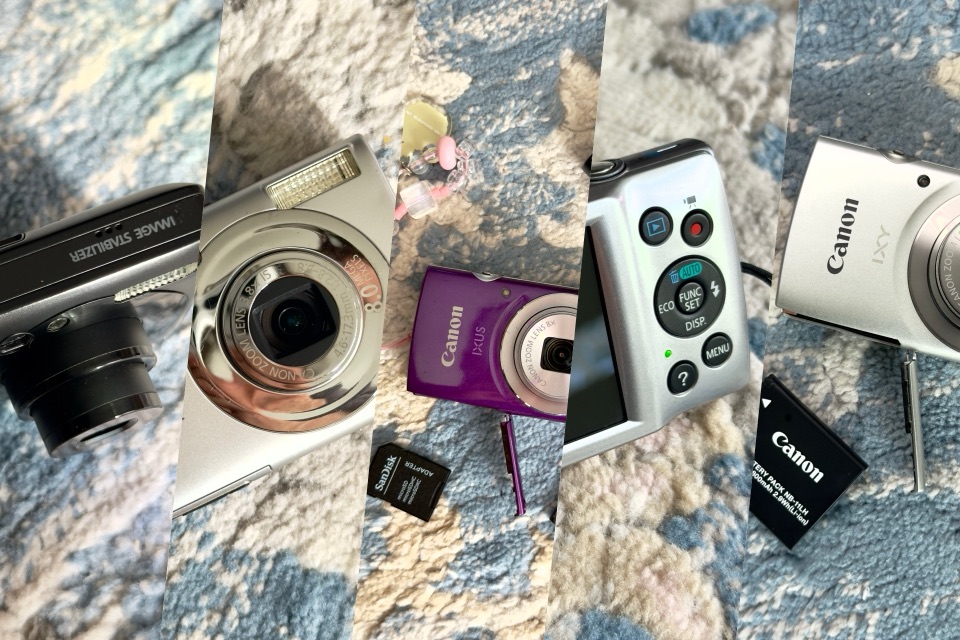
Also look carefully at the listing photographs.
We photograph every Dear Digi camera individually because two copies of the same IXUS can have completely different lives behind them. A twenty-year-old camera should be allowed to have small marks. You just deserve to know what they are before it arrives.
Is a Canon IXUS actually better than another digicam?
Not automatically.
Canon did not invent the only good compact camera of the 2000s. Nikon Coolpix, Panasonic Lumix, Sony Cyber-shot, Olympus, Fujifilm and plenty of others made excellent little cameras.
The reason to buy an IXUS is not that the badge guarantees a particular “vintage” look.
Buy one because you like the design, the size, the controls, the lens and the way Canon approached compact cameras in that period.
The best digicam is still the one you bring with you. If you are still weighing up brands rather than models, our beginner guide is the better place to start, and you can always just look at what is on the shelf today.
The model matters. The individual camera matters more.
This is the slightly inconvenient truth behind every “best camera” guide.
We can tell you that the IXUS 80 IS is our favourite classic all-rounder.
We can tell you the IXUS 220 HS is more versatile.
We can tell you the IXUS 860 IS has the more useful wide lens, or that the IXUS 100 IS is beautifully thin.
But these cameras are no longer identical products coming off a shelf.
They are individual objects with individual histories.
One has spent fifteen years in a drawer.
Another has been carried through three countries.
One still has a strong original battery.
Another needs a replacement.
One has perfect corners.
Another has a tiny scratch that proves somebody actually used it.
That is why we would never choose an old compact from a model number alone.
Choose the right IXUS, then choose the right individual camera.
And once you find one you want to carry everywhere, stop comparing specifications and go take photographs.
Real cameras. Real pictures. Real stories. ♡